
Rhipsalis, also known as mistletoe cactus, is a family of epyphitic cacti native to Central and Southern America. There are over 35 different species of this plant, so Rhipsalis can come in all different shapes and sizes!
Naturally found in the understory of trees, Rhipsalis prefers bright, indirect light and can tolerate direct morning and evening light. The best place to put it is at least a few feet removed from a window, but Rhipsalis is an extremely hardy plant. It can subsist on minimal light for extended periods, especially with some low grade fertilizer. We’ve even seen it subsist on fluorescent light alone! However, if you go the low-light route we recommend recharging your plant in a higher light area every once in a while.
If you are unsure of the lighting conditions in your home or office, we have a guide for how to measure light in your space.
Showing all 12 results
-
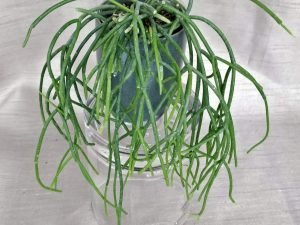
Rhipsalis Baccifera – Spaghetti Cactus
Read more🌿🌿🌿Rhipsalis Baccifera🌿🌿 (Mistletoe Cactus or Spaghetti Cactus),a tropical succulent native to rainforests in warm regions, is characterized by long thread-like stems and creamy-white flowers that give way to mistletoe-like fruits. This plant forms hanging clusters that are typically 3 feet long or greater when mature. This is by far the most commonly grown cacti in the genus.🌿🌿
This plant is found in Florida, Mexico, and Brazil. Surprisingly, growing Rhipsalis requires shade to partial shade. While most cacti are found in hot, sunny, arid zones, mistletoe cactus is unique in its requirements for moisture and dim light. Take some tips on how to grow mistletoe cactus and enjoy this unique and entertaining looking plant.
-

Rhipsalis Baccifera Horrida Rat Tail (Large)
Read moreRhipsalis Baccifera s. Horrida (native to Madagascar) , also known as Rat Tail or Mouse Tail Cactus, is a sub tropical trailing plant with hairy stems that start upright then spill over making it the perfect hanging plant to dangle over a shelf or plant into a hanging planter.
It is an epiphytic cactus, meaning it likes to grow onto a plant or tree but not in a harmful or parasitic way.
It has foliage that appears on branching stems about 5-7mm in diameter, tapering to a point. Just like a mouse’s tail! It is a great plant for displaying in a hanging basket because the plant can grow quite long. It will therefore drape far out of the pot. Water freely when in growth, but keep dryer in winter. Mist the leaves regularly with water to increase humidity and make sure the winter temperatures stay above 10°C.
-

Rhipsalis Baccifera Horrida Rat Tail (Small)
Read moreRhipsalis Baccifera s. Horrida (native to Madagascar) , also known as Rat Tail or Mouse Tail Cactus, is a sub tropical trailing plant with hairy stems that start upright then spill over making it the perfect hanging plant to dangle over a shelf or plant into a hanging planter.
It is an epiphytic cactus, meaning it likes to grow onto a plant or tree but not in a harmful or parasitic way.
It has foliage that appears on branching stems about 5-7mm in diameter, tapering to a point. Just like a mouse’s tail! It is a great plant for displaying in a hanging basket because the plant can grow quite long. It will therefore drape far out of the pot. Water freely when in growth, but keep dryer in winter. Mist the leaves regularly with water to increase humidity and make sure the winter temperatures stay above 10°C.
-
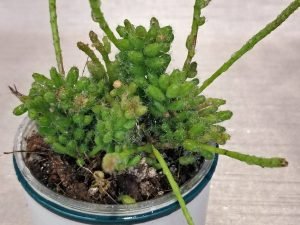
Rhipsalis Mesembryantnemoides
Read more🌿🌿Rhipsalis Mesembryanthemoides is an epiphytic plant with strong stems covered by tiny branchlets. Initially this plant grows erect, later it is pendent, branching free. The main branches are elongated, cylindrical and woody, up to 20 cm long and 1 to 2 mm in diameter. The white flowers appear at areoles of the branchlets. The berries which adorn the leafy segmented stems are white and almost transparent.🌿
This plant is commonly called ‘Clumpy Mistletoe Cactus’🌿🌿
-
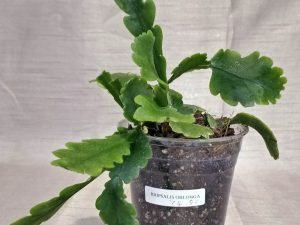
Rhipsalis Oblonga
Read moreRhipsalis Oblonga is an epiphyte which reaching 2.50 m long, branching apical or lateral. Stem segments flattened to rarely triangular in longitudinal section, 0.5-0.8 mm diameter, olive-green or light green, slightly succulent, monomorphic, 8-15 cm long.
The flowers are borne along the sides of the branches, solitary at the areoles. The fruit is globular to short-oblong, 3 to 4 mm long, nearly white, naked, crowned by the withered perianth. -

Rhipsalis Oblonga
Read moreRhipsalis Oblonga is an epiphytic cactus with olive green or light green, semi-erect to pendent, up to 8.2 feet (2.5 m) long segmented stems. The main stems are up to 8 inches (20 cm) long, up to 0.4 inches (2 cm) across, cylindrical at the base, becoming flattened above and branching apical or lateral. The stem segments are up to 6 inches (15 cm) long, up to 2.4 inches (6 cm) wide, with serrated margins and large areoles. Flowers are yellowish-white and appear during the rainy season. Fruits are spherical, up to 0.3 inches (0.7 cm) in diameter, translucent, greenish to nearly white at maturity.
-

Rhipsalis Paradoxa (Extra Large)
Read moreRhipsalis Paradoxa is a forest succulent that is an epiphyte in nature and grows in the form of long, beautiful, chain-like vines that hang from their pot and look untidy, yet gorgeous. These are one of the most beautiful species from the cactus family of plants and are, unfortunately, expected to become extinct if the habitat loss persists at the same rate as it is now.
-

Rhipsalis Paradoxa (Medium)
Read moreRhipsalis is the largest and most diverse genus of epiphytic cactus plants. Members of this genus are around 30 to 60 in number and are popularly known as Mistletoe Cacti. Joseph Gaertner described this Brazilian native oldest genus of flowering cacti in 1788.
The majority of the plants grow as pendulous epiphytes, while a few are epilithic and terrestrial growers. Furthermore, the stems of the Rhipsalis plants are succulent in nature. However, the extent of succulence is variable among the species. As far as appearance is concerned, the stem shape of the plants can be terete, angular, or flat.
-
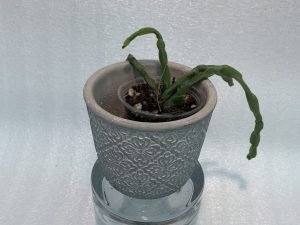
Rhipsalis Paradoxa (Small)
Read moreRhipsalis Paradoxa is a unique cactus discovered by Joseph Salm-Reifferscheidt-Dyck in 1845. This evergreen cascading succulent forms green and dandy branches about 1 inch wide and can grow meters long. The leaves are attached in an unusual way making links and joined at right angles.
-
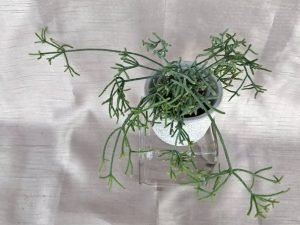
Rhipsalis Pilocarpa
Read more🌿🌿🌿Rhipsalis pilocarpa also called as the hairy-fruited wickerware cactus. The plants main feature is the long green stem that grows in every direction often lighter green around the tips.🌿🌿🌿
🌿🌿The hairy-fruited wickerware cactus blooms with very fragrant, opening slowly, up to 2 cm broad flowers that appear alone or in pairs at ends of terminal branches. The pericarp is covered with bristle-like spines. The wine-red, berry-shaped fruits are spherical and studded with bristle-like spines. The fruits contain quite large, black seeds.🌿🌿
-
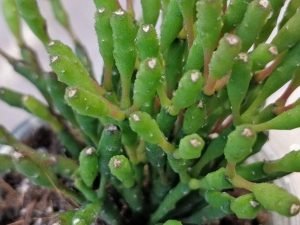
Rhipsalis Salicarnioides | TropicalXay
Read more💚💚Rhipsalis Salicarnioides is a slender, erect, arching or somewhat pendent, bushy, cactus with unique jointed stems and many small yellow-orange flowers. It can be either epiphytic or terrestrial, but is commonly grown as a foliage plant. The plant is made of many-branched stems and reaches 30-60(-100) cm in height and spread. It is said that it deserves first place among the Cacti of easy culture.💚💚
Other common name for this plant are ‘Dancing Bones, ‘Drunkard’s Dream’, ‘Bottle Cactus’.
-
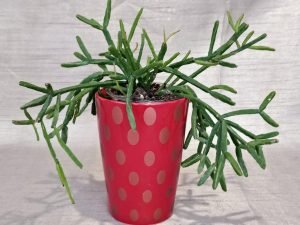
Rhipsalis Trigona
Read more☀☀Rhipsalis Trigona is a pendant much-branched ephiphytic cactus that can reach upto 6.6 feet in length. the stems segments are stout, 3-angled, often curved or twisted. It has white or pale pink flowers.☀☀